There are journeys we plan for scenery, and then there are journeys that quietly rearrange the furniture inside us. Mine began not as an escape, exactly, but as a pause. I had been working in the polished, high-pressure rhythm of a South African advertising agency. On paper, my life looked assembled. A good job. A relationship. A future that should have felt secure. Yet beneath it all was a restlessness I couldn’t name.
The realization didn’t arrive dramatically. It came one evening at an art exhibition, sitting with two friends and a half-finished bottle of wine, listening to them talk about rent, unpaid work, borrowed space, and the impossible economics of being an artist. They had very little. Somehow, they also had something I couldn’t seem to find: ease. Joy. A kind of uncomplicated happiness.
I remember watching them and thinking, almost with envy, that they were the lucky ones. Not long after, work took me to Phalaborwa, a town near one of South Africa’s most iconic wilderness areas: Kruger National Park. I was there to run a workshop at a mine, but once the professional part was done, I stayed on. I told myself I needed time to think. In truth, I needed distance from the noise of my own life.
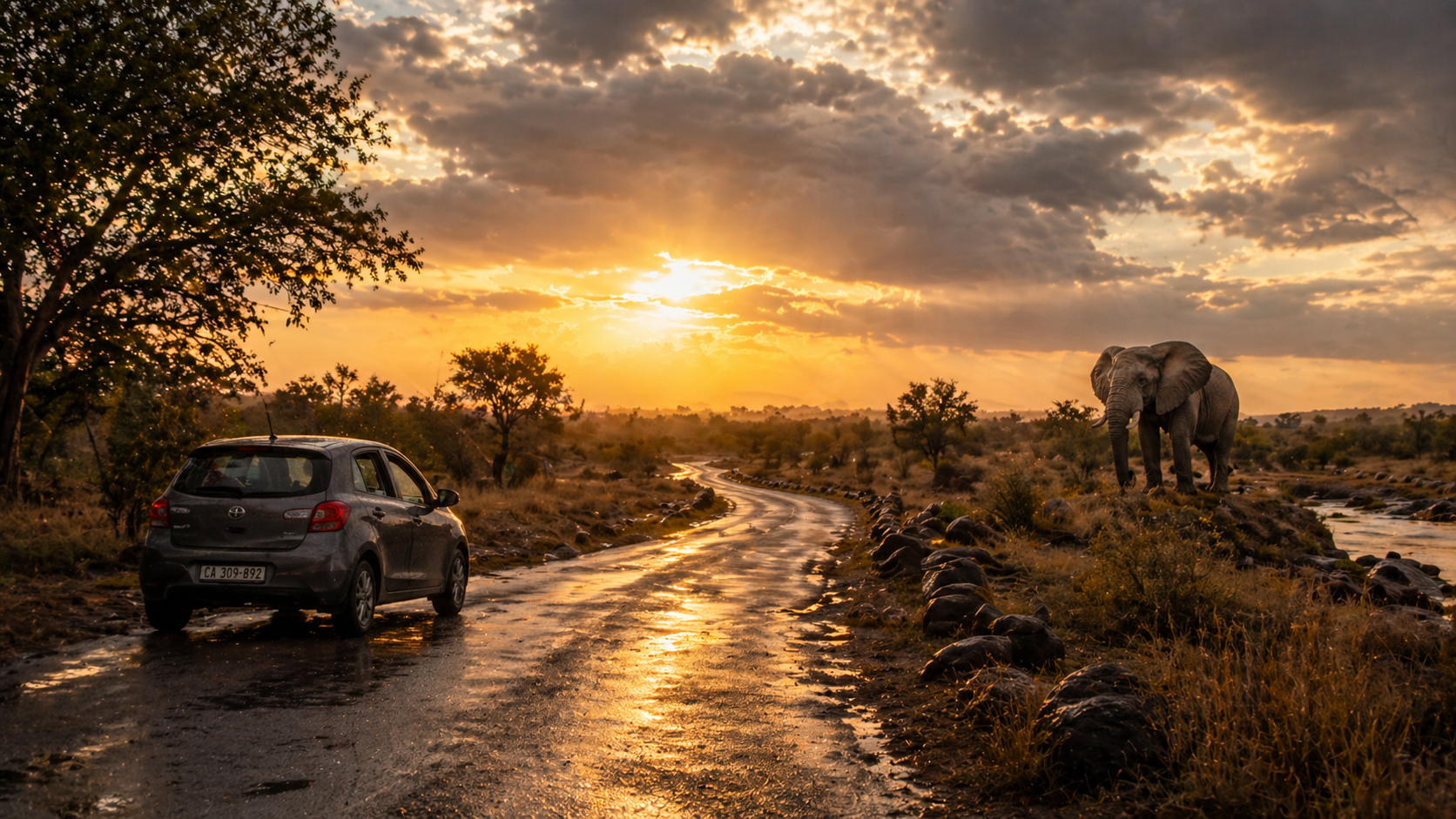
By the morning I drove into Kruger, the roads were still damp from an early thunderstorm. The bush had that rinsed-clean feeling that comes after rain. Every leaf seemed newly awake. The tar road held shallow puddles, and not far beyond the gate, a black-backed jackal stood drinking from one of them. I stopped the car. The jackal looked up, stretched as if the day belonged entirely to him, then slipped back into the bush. It was a small moment, but something in me softened. The park had barely begun, and already it was asking me to slow down. Kruger is not a place that performs on command. It reveals itself in fragments: a flick of an ear between branches, the white flash of an impala’s tail, the heavy-winged flight of a hornbill, the sudden stillness that makes you scan the grass for movement. That morning, because the air was cool and the day still young, the bush felt alive in every direction. There were impala everywhere, elegant and alert, those familiar black markings on their rumps giving them the old safari nickname of “McDonald’s”, the fast food of lions. Hornbills strutted through the roadside dust. Squirrels darted across the road as though late for appointments of enormous personal importance.
Driving alone changes the way you experience a place. There is no one to distract you, no conversation to fill the gaps. Every sound becomes sharper. Every decision is yours. You stop when you want. You sit in silence as long as you need. You become, for a while, both traveler and witness. Later, I pulled into a rest stop near a river. As I walked toward the restaurant and shop, I noticed a duiker in the bushes with her young. She startled when she saw me. I froze, then stepped back. “Don’t worry, mama,” I whispered. “It’s okay.” For one brief second, we looked at each other. Then her body tightened, and she and her little one sprang from the bush and vanished beyond the parking area. It was over almost before it happened, but I carried the tenderness of it with me.
Inside, I ordered a toasted ham and cheese sandwich, browsed the shelves, and bought a T-shirt that made me laugh. Outside, I sat at a table overlooking the dry riverbed. Across the way, waterbuck grazed in the pale distance. That was the moment I finally began to breathe. Not solve. Not decide. Just breathe. There is a particular kind of silence in the bush that is not empty at all. It holds insects, birds, wind, the occasional crackle of dry grass. It holds the possibility that something enormous might step into view at any moment. It asks nothing from you except attention.
After lunch, I chose a circular route back toward the gate. The road dipped toward a dry riverbed, its sandy floor still holding the memory of water beneath the surface. That was where I saw him. A lone elephant. He moved slowly, with the unhurried confidence of something that has no need to explain itself. From inside a small rental car, an elephant is not simply large. He is landscape. He is weather. He is a mountain with a heartbeat.
I watched as he crossed the road and stepped down into the riverbed, following the sandy channel. Farther along, our paths met again. I stopped and let the car idle into silence. He was walking toward me. Every few steps, he paused, pressed his trunk into the sand, and dug. Then he drew up water hidden beneath the dry surface and lifted it to his mouth. I could hear everything. The soft scrape of sand. The suction of water through his trunk. The wet rush as he drank. It was beautiful. Then it became terrifying. He kept coming closer, and only then did I notice that my window was slightly open. Too late to start the engine. Too late to reverse without startling him. Too late, really, to do anything except sit perfectly still and hope that this ancient, intelligent creature found me too boring to investigate with enthusiasm. His tusks came into view first. Then the trunk. It touched the car gently, exploring. The vehicle shifted under his weight as he moved around it. I stopped breathing. Somewhere in the absurd theatre of fear, I had one very practical thought: if this goes badly, will anyone find me? His trunk reached the open window. For a few suspended seconds, the world narrowed to breath, metal, heat, skin, and silence. Then he stepped back. He moved around the rear of the car and continued on, disappearing slowly into the distance as if nothing extraordinary had happened. For him, perhaps, nothing had. For me, everything had.
I sat there for a long time after he left, watching the shape of him grow smaller. When I finally exhaled, it felt as though I had been holding more than air. I had been holding fear. Expectation. The brittle little story I had built about what my life was supposed to look like.
That night, back at the lodge, I stared into the darkness and listened to the bush. The encounter had shaken me, but it had also clarified something. Life, I realized, was far less guaranteed than I had allowed myself to believe. It was also far too precious to spend performing happiness. I had spent years chasing the things that were meant to make me feel complete. Work. Security. Love. Approval. The shape of a successful life. But somewhere along the way, I had misplaced myself. The elephant did not give me answers. Nature rarely bothers with that level of customer service. What it gave me was scale. It reminded me that I was small, alive, temporary, and responsible for the direction of my own life.
When I returned home, the silence waiting for me was different from the silence of Kruger. It was heavier. More human. More complicated. The following morning, I went to work and sat in a management meeting where people spoke about frustration, sameness, and all the reasons things couldn’t change. I listened for a while. Then I stood up, walked to my office, and wrote my resignation letter. I placed it on my boss’s desk and told her that nothing she offered would change my mind. It sounds impulsive from the outside. It wasn’t. The decision had been forming for a long time. It simply took a wet road, a jackal, a duiker, a sandwich, a dry riverbed, and one very large elephant to bring it to the surface.
Solo travel is often sold as freedom, and it is. But it is also confrontation. Without the comfort of familiar company, you meet yourself more clearly. You hear the thoughts you’ve been outrunning. You notice what expands you and what quietly drains you. Kruger gave me beauty, fear, stillness, and perspective. It taught me, with no sentimentality at all, that happiness is not something another person, salary, title, or perfect life arrangement can hand you. It has to be built from within. Only then can love become an addition, not a rescue mission.
I also learned to keep the window closed when elephants are nearby. Some lessons arrive wrapped in wisdom. Others arrive with tusks.