August 10, 2026
When evidence becomes brand risk
Taylor Farms has found itself back in the headlines. This time, prepared foods containing jalapeños are being recalled after supplier Coast Citrus pulled peppers connected to a multistate Salmonella outbreak. Importantly, Taylor Farms has not been identified as the contamination source, and no illnesses are currently linked directly to its recalled finished products. Normally, that distinction would offer considerable protection. But this isn't happening normally.
Only weeks earlier, Taylor recalled iceberg lettuce after FDA traceback and epidemiological evidence connected lettuce from Taylor Farms de Mexico with a major Cyclospora outbreak. The FDA later withdrew a positive product test as a false positive, while maintaining that the broader evidence still points toward Taylor's lettuce. Then another layer appeared.
A congressional inquiry is now examining allegations that Taylor may have tried to influence the FDA investigation and questioning some of its public communications. Those are allegations, not findings, but they change the nature of the challenge.
From a brand strategist's perspective, Taylor Farms is no longer dealing with one crisis. It is dealing with trust compression. Operational risk, supplier risk, scientific uncertainty and corporate credibility are being compressed into one public perception. And markets move on perception long before investigations finish.
Reuters reports U.S. iceberg lettuce unit sales fell 15.3% year over year during the four weeks ending July 25. Consumers appear to be pulling back from lettuce more broadly, not simply Taylor products.
That is where this becomes economically serious. Taylor Farms supplies retailers and restaurant groups at enormous scale. Its biggest risk may not be millions of consumers consciously boycotting the brand. It may be procurement executives quietly reducing exposure. A customer shifting Taylor from 70% of a category to 50% does not generate a dramatic headline. But for a business associated with roughly $7 billion in annual product sales, losing just 1% represents around $70 million in revenue exposure.
So what would I do?
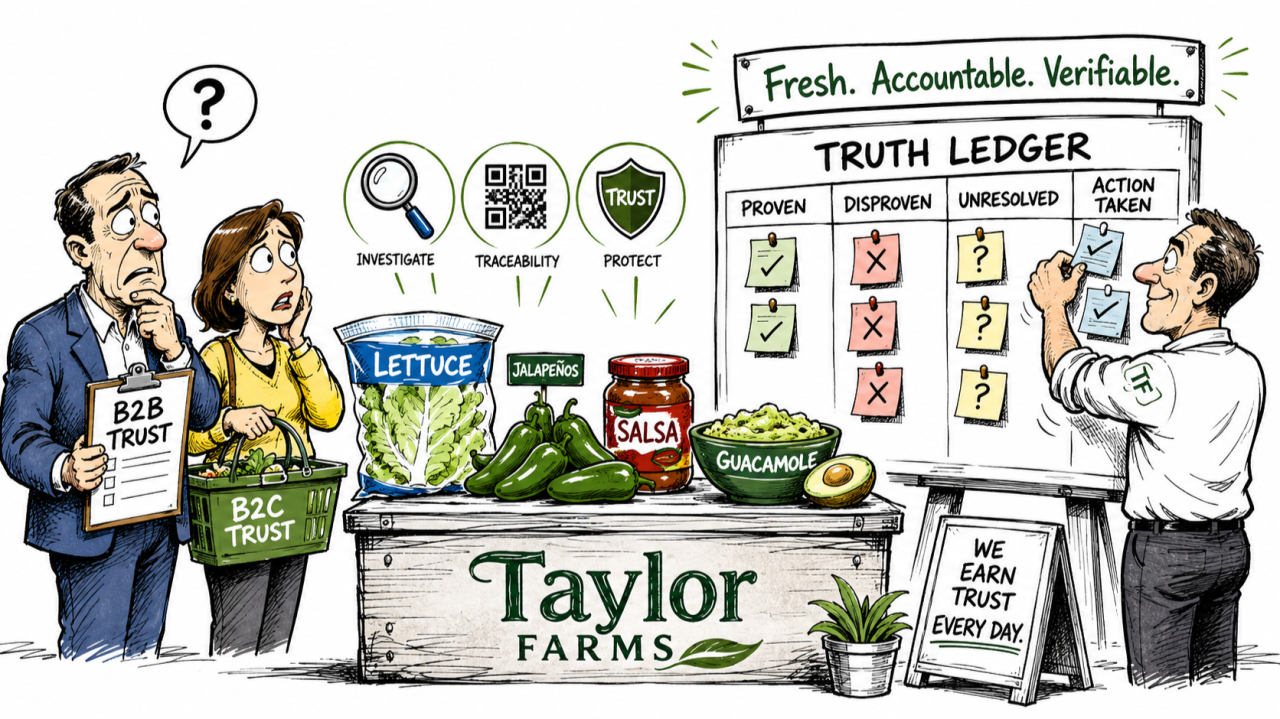
I would stop trying to communicate certainty where certainty does not yet exist. Instead, Taylor should publish a Truth Ledger for every active investigation:
PROVEN What evidence confirms.
DISPROVEN What evidence has shown to be wrong.
UNRESOLVED What investigators still do not know.
ACTION TAKEN What Taylor changed anyway.
Then make that philosophy operational. Give major customers access to supplier audits and traceability data. Publish independent food-safety findings. Make grower and lot information accessible through product QR codes. Create an independent science and trust council. Publish substantive regulatory interactions while scrutiny remains high. And when contamination begins upstream, do not simply say, "It wasn't ours." Say: It entered our supply chain. Here is what we changed to reduce the chance of that happening again.
That is the difference between defending reputation and rebuilding trust. Taylor Farms can recover from this. Its scale, distribution network and existing food-safety investment give it resources smaller competitors simply do not have. But recovery should not be measured by when the headlines stop. It should be measured by whether retailers, restaurants and consumers eventually have more evidence to trust Taylor than they had before the crisis began.
That is the opportunity. Turn transparency from a crisis response into a competitive advantage. For brands operating complex supply chains, how much of your trust promise could your customers independently verify today?
#TaylorFarms #BrandStrategy #CrisisManagement