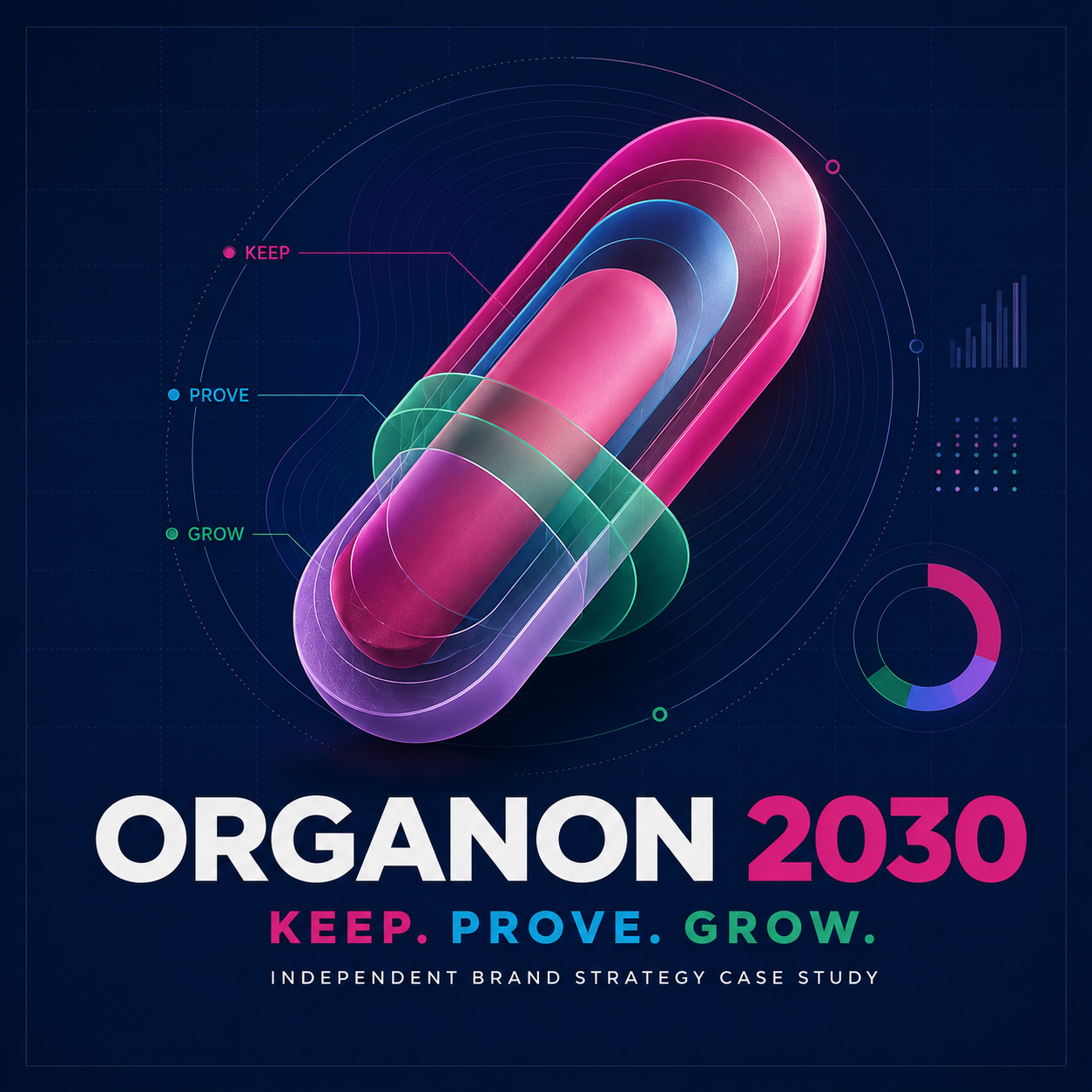
Organon 2030: Keep. Prove. Grow.
When keeping a brand becomes a business decision

Full absorption was the easier option.​​​​​​​ It would reduce duplicate costs, simplify control, and move Organon into Sun Pharma’s operating system. The harder question was whether the Organon name still carried enough value to justify keeping it.

This project examines that question through microeconomics, competition, customer needs, brand architecture, marketing, risk, crisis planning, and product communication.
The answer was not to protect Organon at any cost. The recommendation was to keep the brand only while it could prove its value.

Independent project disclosure
This independent portfolio project uses public information available through 9 August 2026. Organon, Sun Pharma, NEXPLANON, and the competitors referenced did not commission or approve this work. The financial figures are planning scenarios, not company guidance or achieved results. All product communication remains conceptual and would require formal Medical, Legal, and Regulatory review.

This was never just a logo question
Keeping a brand after an acquisition can appear to be a communication choice. In practice, it creates a second operating responsibility.

A retained brand requires funding, governance, medical control, data management, customer support, regulatory oversight, supply protection, and clear accountability.
Without these capabilities, Organon would become an expensive label attached to an absorbed business.

My role covered brand strategy, marketing analysis, research, creative direction, and commercial planning. I reviewed public filings, transaction announcements, competitor portfolios, regulatory guidance, customer barriers, and economic scenarios.

The work included:
• Full absorption versus retained-brand economics.
• Competitor mapping across women’s-health need-states.
• Competitive advantage and customer positioning.
• Target audiences and brand architecture.
• A five-year marketing and expansion plan.
• Risk, governance, crisis readiness, and exit rules.
• Board, agency, advertising, and creative briefs.
• A product-level launch application for NEXPLANON.

The economic starting point
Organon reported $6.216 billion in 2025 revenue and a 60.1% adjusted gross margin. Women’s health contributed $1.752 billion, representing 28.2% of total revenue. First-half 2026 revenue declined to $3.018 billion. NEXPLANON sales declined to $431 million, and debt stood at $8.553 billion on 30 June 2026. The announced transaction valued Organon at about $11.75 billion in enterprise value. The combined company was expected to produce about $12.4 billion in annual revenue. A preliminary $700 million integration-savings estimate created a commercial opportunity. It did not create a dependable source of brand investment.

This distinction shaped the entire project. Integration savings cannot automatically become marketing funding. Every retained-brand cost must compete with debt reduction, product investment, supply resilience, and shareholder expectations.

Absorption versus brand retention
Full absorption offered a cleaner operating model. It could remove duplicate costs, reduce decision layers, accelerate control transfer, and place the portfolio under one corporate identity. The trade-off was the loss of Organon’s category focus, partner visibility, employer identity, and women’s-health association.

Retaining Organon could preserve these assets. It could also provide Sun Pharma with a recognised platform for women-specific and reproductive care. The cost would include continuing marketing, governance, customer research, compliance, medical support, crisis preparation, and brand management. Brand retention only made economic sense if Organon could generate more value than these costs.

The recommendation
I recommended retaining Organon as a protected women’s-health brand endorsed by Sun Pharma. The proposed relationship would be expressed as: Organon, a Sun Pharma company. This recommendation was conditional. Organon would operate as a controlled growth option rather than a permanently protected corporate name. Four gates would govern continued investment:

Truth gate: A product, evidence program, access improvement, or named partnership must support each brand promise.
Customer gate: Research must show improved understanding, access, adoption, professional support, or partner preference.
Economic gate: Product and market cases must support defined revenue, contribution, and investment hurdles.
Control gate: Supply, quality, safety, promotion, privacy, data, and reporting must have accountable owners.

At month 18, leadership would choose one of four paths: scale the brand, hold investment, narrow Organon to name-only use, or retire it. 

Competition is organized around needs 

Women’s health is not one market. Contraception, fertility, menopause, gynecology, maternal health, and women-specific conditions each have different customers, barriers, channels, and competitors. 

Bayer carries major contraception franchises. CooperSurgical operates across fertility devices, services, birth, and clinical workflow. Ferring has a focused fertility identity. Astellas is building a menopause position. AbbVie owns selected condition and contraception assets.

Organon should not position itself as the answer to every women’s-health need.
Its credible opportunity is narrower. Organon could become a medicines-led platform for reproductive and women-specific care. It would combine category experience, recognised products, local market access, patient support, and Sun Pharma’s financial and operating reach. This position does not claim clinical superiority. It describes a business capability that Organon and Sun Pharma would still need to prove.

The proposed competitive advantage 

Organon’s advantage would be its ability to commercialize reproductive and women-specific treatments across markets. 

The platform would combine:
• Specialist women’s-health experience.
• Recognized regulated product brands.
• Local market and payer knowledge.
• Healthcare professional relationships.
• Patient access and support programs.
• A focused home for external partner assets.
• Sun Pharma’s capital and operating reach.

Brand awareness alone cannot prove this advantage. The business would need to demonstrate better customer understanding, wider access, dependable supply, partner preference, and measurable financial contribution. 

Positioning from the customer’s point of view
The customer position is simple: For people making decisions about reproductive and women-specific care, Organon makes trusted treatment choices easier to understand, reach, and continue through specialist experience, global access, and Sun Pharma’s resources.

The investor position supports a different decision: Organon is Sun Pharma’s protected women’s-health growth platform, built to convert category focus, global reach, and partner assets into measured revenue, access, and cash contribution.

Seven attributes support the position:
• Women-centred choice.
• Evidence-led care.
• Specialist category depth.
• Global market reach.
• Dependable access.
• Partnership readiness.
• Visible accountability.

Quality is an entry requirement. Price is not the competitive advantage.
A broader life-stage promise should remain an ambition until the portfolio can support it.

Target audiences
The target market was built around care decisions and barriers, not broad demographic labels.

Priority audiences include:
• Healthcare professionals making treatment and referral decisions.
• Adults considering or using prescription contraception.
• Fertility patients and families managing complex treatment journeys.
• Payers, governments, health systems, and tender authorities.
• People living with women-specific conditions.
• Biotech and academic partners seeking a focused commercial home.
• LGBTQ+ people seeking respectful reproductive or gynecologic care.

Age, geography, education, occupation, values, lifestyle, and financial access can refine communication. They cannot replace medical eligibility, payer reality, or provider access.

A focused brand architecture
The proposed architecture separates the corporate promise from regulated product communication.

Endorsed master brand: Organon, a Sun Pharma company.
Category platform: Organon Women’s Health.
Product brands: NEXPLANON, Follistim, and other established product names.
Non-core portfolios: Established medicines and biosimilars operating through Sun Pharma platforms.

This structure protects Organon’s women’s-health meaning without forcing every medicine into the same story. Product names, approved claims, and required legal markings would remain where regulation and market evidence support them.

Marketing must make care easier
The marketing plan was designed to reduce customer barriers rather than produce general awareness.

Four platforms guide the work:
• Choice you can act on
• Patient education, decision aids, and practical questions for healthcare discussions.
• Access without dead ends
• Coverage guidance, referral support, treatment-start information, and clear supply communication.

Evidence in practice: Healthcare professional education, real-world evidence, workflow tools, and balanced product information.

Progress people can see:  A public scorecard covering access, supply, research, partnerships, and trust. Marketing would guide people from recognizing a need to discussing care and confirming access.

Medical, patient services, market access, commercial teams, and compliance would own the stages that require specialist control.

The five-year investment plan
The proposed 2027 to 2031 marketing plan totals $290 million. This includes $40 million for one-time transition work and $250 million for recurring marketing.

Annual recurring investment would remain below a $55 million ceiling. The plan also leaves $25 million below the original five-year planning limit. Customer and professional research receives $23 million because the positioning still requires proof. The remaining budget supports healthcare professional education, patient access, paid media, partnerships, content, market testing, and measurement.

Paid demand should only begin when supply, access, provider capacity, customer service, privacy, and regulatory controls are ready.

Expansion must remain reversible
The expansion plan begins with six controlled United States pilot cells in 2027.
Successful programs could then expand in stages:
• 2027: Six United States pilot cells.
• 2028: The United States and no more than two English-language markets.
• 2029: Up to eight active markets.
• 2030: Up to twelve active markets.
• 2031: A maximum of fifteen active markets.

Weak programs would be repaired, reduced, or closed. Market entry would depend on local customer proof, access conditions, supply capacity, and financial contribution.

The profitability hurdle
The retained-brand model requires about $91.5 million in annual women’s-health revenue to cover recurring brand costs in the base planning case. The staged three-year case requires about $113.7 million in annual contribution. Under the endorsed-base scenario, the investment becomes cumulative-positive during the 2029 financial year. This is a planning milestone. It is not GAAP profitability, company guidance, or a risk-adjusted valuation.

The gaps that could stop the strategy
The brand case was strongest in positioning, architecture, audience logic, and customer value. It was weakest where a board would require internal operating evidence.

Five gaps must be closed before full investment:
• Product and country-level economics.
• A protected operating model with named owners.
• Regulated control transfer across safety, quality, privacy, promotion, and data.
• Customer proof that the offer changes behavior or access.
• Portfolio resilience across pipeline, supply, exclusivity, and partnerships.

Each gap requires an accountable owner, deadline, evidence standard, and stop rule.
Protecting the brand before a crisis

Brand protection cannot begin after the event.
I developed a crisis-management system covering product safety, recalls, quality, supply, privacy, cyber events, misinformation, workforce harm, acquisition tension, pricing, litigation, patent loss, and partner disputes.

The system includes ten scenario playbooks, severity levels, response timing, decision rights, stakeholder order, holding statements, recovery gates, and post-event reviews.
A proposed $9 million five-year readiness budget supports monitoring, training, simulations, specialist partners, and annual maturity work. Incident execution and customer remediation would require separate financial authority.

Applying the strategy to NEXPLANON
NEXPLANON became the product-level test for the wider strategy. The brief examined how the corporate position could become an audience, channel, budget, research, and creative program.

Three investment levels were developed:
• $9.2 million controlled pilot.
• $18.5 million national base plan.
• $27 million accelerated plan.

The accelerated option should only proceed when supply, coverage, trained-provider capacity, safety operations, and regulated customer intake can support increased demand.

The proposed creative platform was:
• Your timeline. Your talk.
• The idea invites adults to explore a longer planning horizon through an informed healthcare conversation.
• It does not tell the audience which life path to follow. It also avoids suggesting control over every personal or medical outcome.
• The creative system begins with a question, states the approved product role, presents risk clearly, and moves toward a trained healthcare discussion.
• The visual language avoids pregnancy-test panic, biological clocks, partner pressure, narrow feminine codes, and “set it and forget it” claims.

The outcome
The outcome was not a campaign. It was a decision system. The work connects economics, customer relevance, brand meaning, marketing, governance, crisis response, and creative execution. Every recommendation carries evidence requirements, budget limits, accountable owners, and exit rules. Because this is a speculative project, I do not present forecasts as achieved company results.

The portfolio value lies in the reasoning and its translation into board decisions, brand architecture, operating controls, agency briefs, and product communication. A brand should never appear more confident than the business behind it. Strategy must make the business capable of keeping its promise.

Project documentation
Organon Brand Strategy 2030
Full economic, market, brand, marketing, risk, and gap 

Brand Protection Crisis Management Manual
Crisis command, scenarios, messages, response timing, and recovery planning.

Brand Protection Agency Brief
Scope, governance, service standards, budget, and agency selection criteria.

NEXPLANON Advertising and Design Brief
Audiences, channels, budgets, testing, launch gates, and compliance controls. https://drive.google.com/file/d/1Y9gLF-RrK8L9AeXjd7utepDBN6Zqm-aU/view?usp=drive_link

NEXPLANON Creative Concept Overview
Creative platform, visual direction, executions, and communication guardrails.https://drive.google.com/file/d/1yNvso27JY4uPSKOtNqSQPDq4VsOZ5k6c/view?usp=drive_link

Independent research, strategic direction, brand architecture, marketing planning, risk framework, crisis planning, and creative direction by Angela Meuwsen.
Back to Top