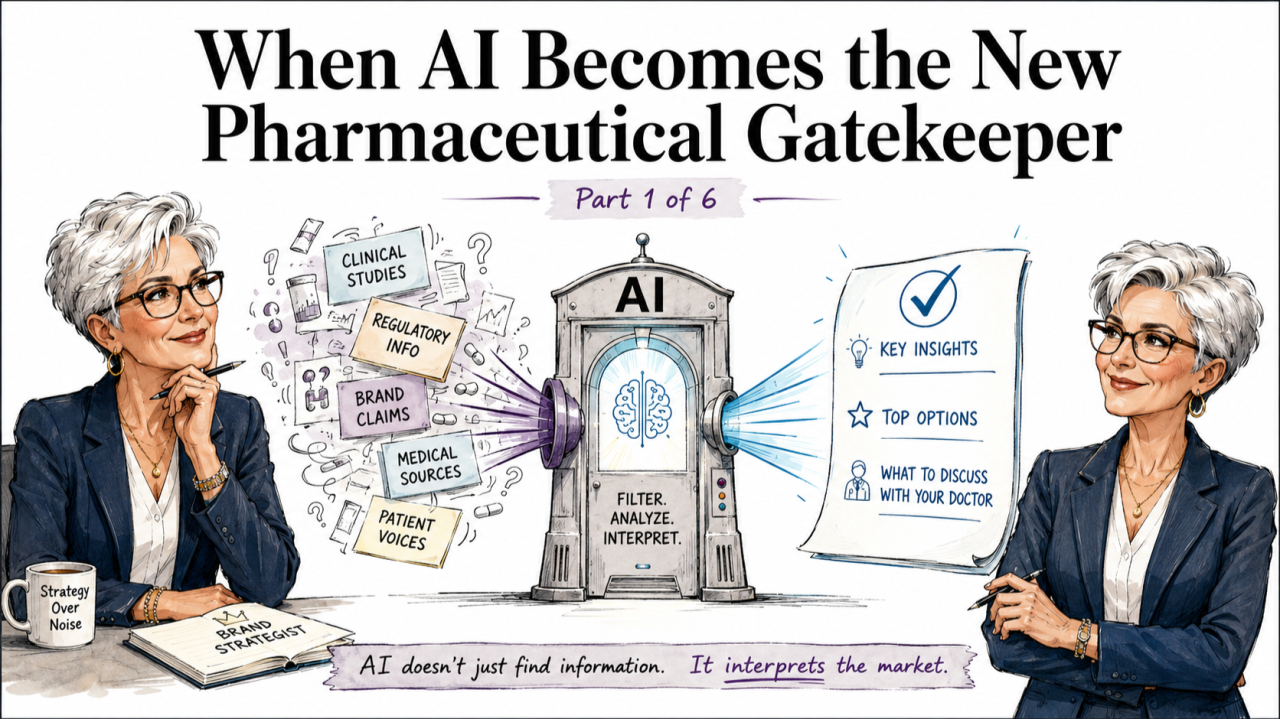
For twenty years, pharmaceutical digital strategy has competed for visibility. Search ranking. Paid media. HCP engagement. Patient education. Disease awareness. Corporate reputation. But there is a structural change happening underneath all of it. We may be moving from competing to be found to competing to be selected. That distinction matters.
A search engine traditionally helped a stakeholder locate information. Generative AI increasingly interprets that information before presenting an answer. For pharmaceutical companies, that creates an entirely new intermediary between the organization and the patient, healthcare professional, payer or investor. And unlike media, AI does not simply distribute the brand message. It may interpret the brand itself.
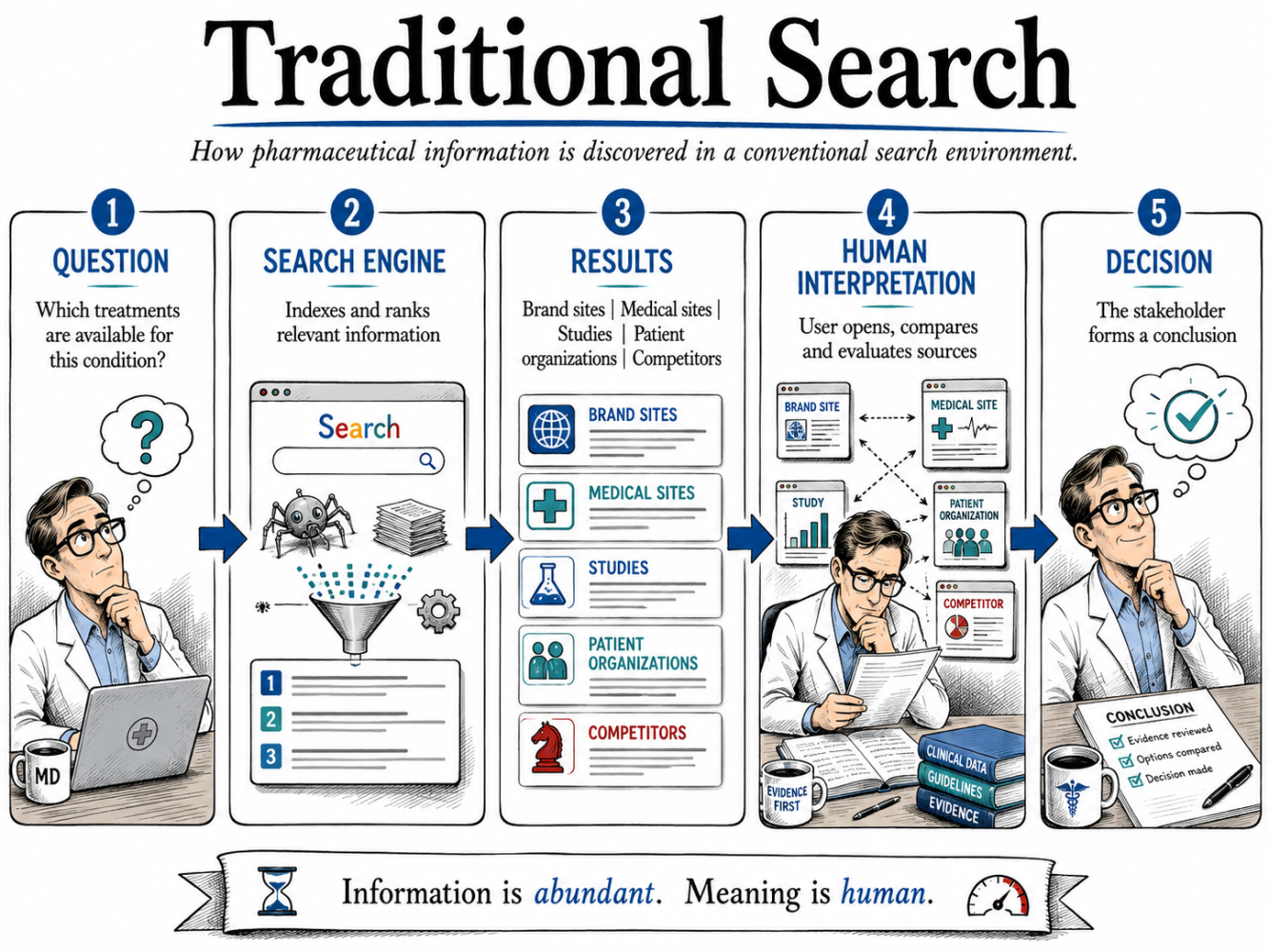
Now compare that with the emerging AI journey.
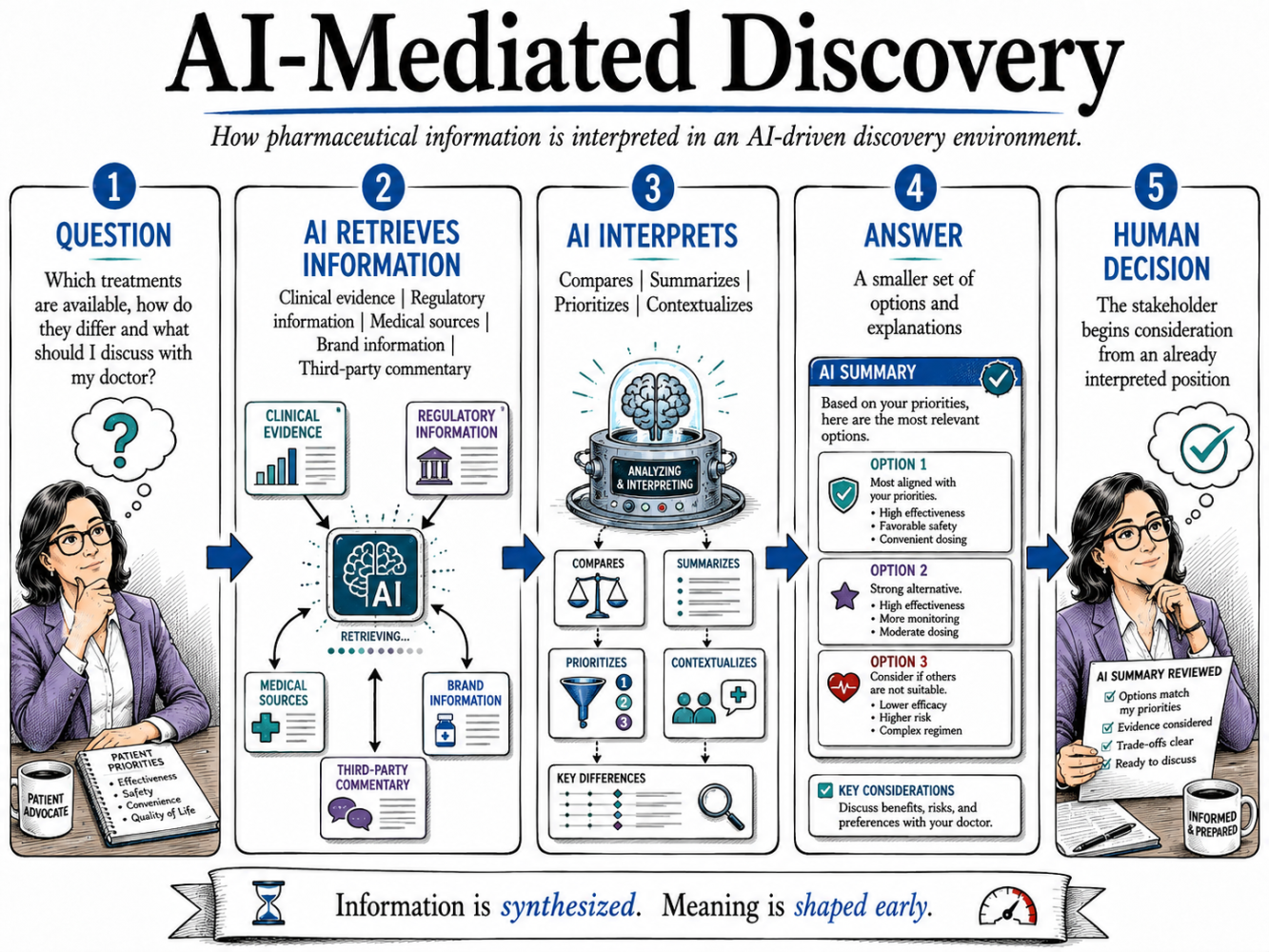
That is the strategic shift. The traditional search environment gives the user sources. The AI environment increasingly gives the user a view of the market.
Deloitte predicts that in developed markets during 2026, around 29% of adults will conduct at least one daily search incorporating a generative AI summary. It expects AI-enhanced search usage to considerably exceed standalone generative AI applications. Healthcare makes the issue particularly important. Deloitte's 2026 Life Sciences and Health Care research reports that almost half of surveyed consumers were already using generative AI in 2024, with health among the principal reasons for its use. Yet only 15% of surveyed life sciences and healthcare executives said their organizations had adapted governance sufficiently to keep pace with the technology. There is an important tension here.
Consumer behavior may be moving faster than corporate governance. For pharmaceutical companies, that creates three strategic exposures.
1. Your brand can be visible and still lose the recommendation.
Traditional digital strategy often treats visibility as success. AI changes that. Being present in the information environment does not guarantee inclusion in the answer. A brand may be discovered, evaluated and rejected without the patient ever seeing its website. That creates a new competitive metric:
Share of Recommendation. Not simply: Are we visible? But: When an AI considers the therapeutic category, are we inside the consideration set, and why?
2. Corporate reputation enters the product conversation.
AI does not necessarily respect the organizational silos companies created for themselves. Corporate affairs may manage reputation. Medical affairs manages evidence. Brand manages positioning. Market access manages economic value. Regulatory manages compliance. AI can retrieve information across all of them.
That means inconsistencies which remain hidden inside corporate structures may become visible outside them. The future AI-mediated pharmaceutical brand therefore requires something more demanding than message consistency. It requires organizational coherence.
3. Accuracy becomes a commercial issue.
In September 2025, the FDA intensified enforcement around misleading pharmaceutical advertising, including digital promotion. In January 2026, FDA and EMA published ten principles for good AI practice in drug development, emphasizing matters including context of use, risk, standards, governance and reliability. The regulatory direction matters. Evidence must withstand scrutiny. Increasingly, so must the information ecosystem surrounding it. The challenge for pharmaceutical marketers is therefore not to “write for AI.” That would be far too tactical.
The challenge is to build a brand whose clinical proposition, evidence, economic value and corporate reputation are sufficiently clear that human and machine interpretation reach broadly the same conclusion. And that changes the job of brand strategy. It moves brand upstream. Closer to evidence. Closer to reputation. Closer to market access. Closer to enterprise governance.
Because when AI becomes an intermediary in healthcare discovery, the most important question may no longer be: “Did they see our brand?” It may be: “When the market was interpreted for them, did our brand survive the interpretation?”
THE BOARDROOM QUESTION
If a patient, physician, payer or investor asked an AI today to explain your therapeutic category, would your leadership team recognize the version of your company it describes?
If the answer is uncertain, that is not an SEO problem. It is a brand governance problem.