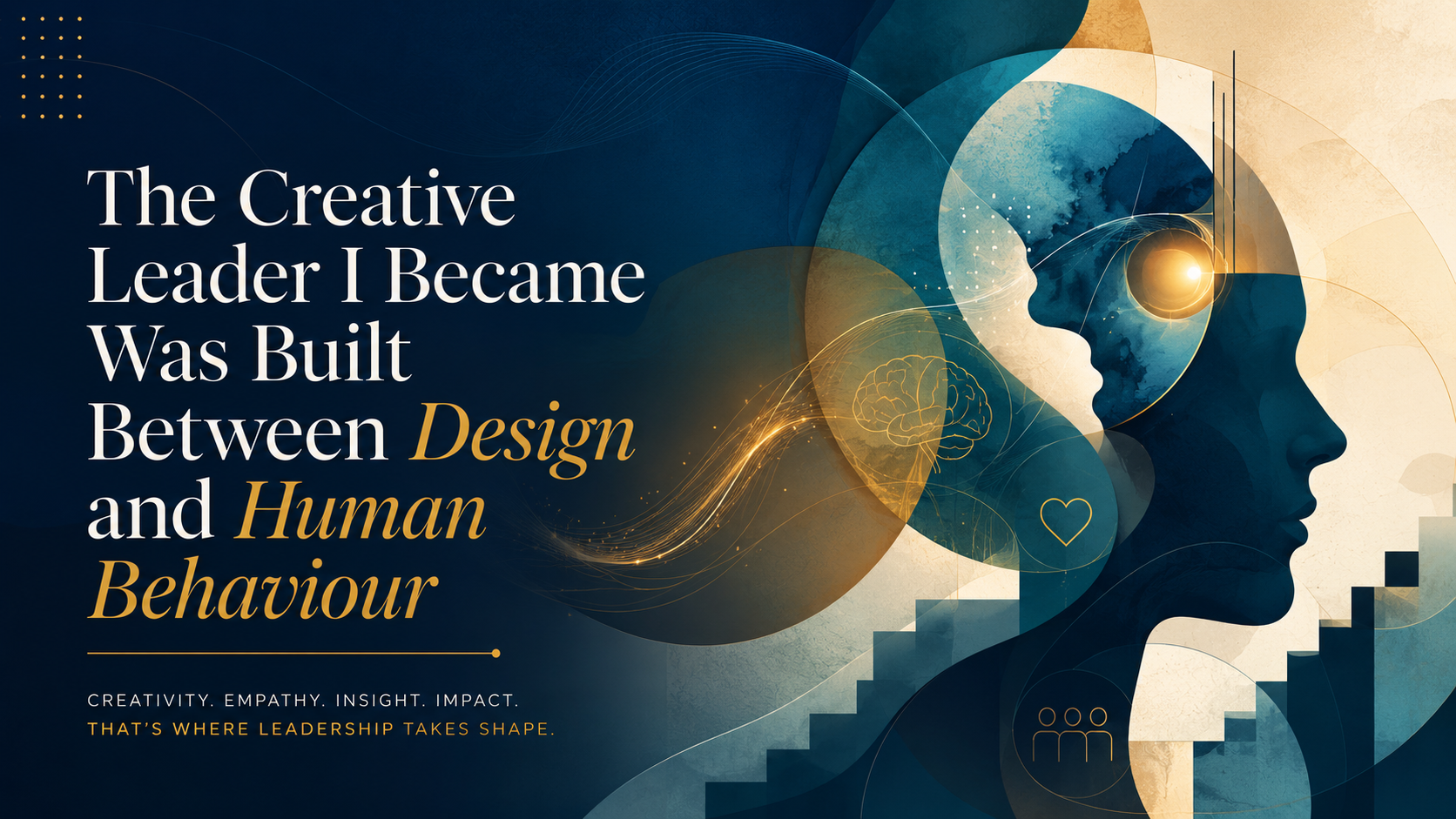
The Creative Leader I Became Was Built Between Design and Human Behavior. I started my career the way most people do, with a dream, a rough idea of what the future might look like, and just enough belief to keep walking toward it.
In my mind, the creative industry was going to be full of bold ideas, beautiful work, inspiring people and clients who understood the value of design from the very beginning. Then, like most juniors eventually discover, the world had other plans. The reality came quickly.
Creativity was not just about having ideas. It was about defending them. It was about listening carefully, reading the room, managing pressure, understanding people, navigating uncertainty and still finding a way to deliver work that mattered. The industry was exciting, yes, but it was also demanding, emotional, fast-moving and often far more complex than I had imagined.
Still, I never moved away from my original dream. I knew I belonged in the creative field. What changed over time was my understanding of what creative leadership really required.
As my career developed, I began to see that great creative work does not happen in isolation. It is shaped by people. By how they think. By what they fear. By what they are trying to achieve but cannot always explain clearly. I started to realise that if I wanted to become a stronger creative leader, I had to understand more than design, brand systems and visual communication. I had to understand human behavior. That was what first led me into EQ studies early in my career.
At the time, I did not see it as a formal turning point. It felt more like a natural extension of the work I was already doing. I wanted to understand how people made decisions, how they responded to change, how they communicated under pressure, and why two people could hear the same brief but walk away with completely different expectations. The glamorous chaos of business, naturally.
Those early studies opened a door. They helped me see that leadership was not just about giving direction. It was about creating clarity. It was about building trust. It was about knowing when to challenge, when to support, when to step back and when to guide a team through the noise. That knowledge changed how I worked with designers, copywriters, photographers, developers, project managers and clients. It made me more aware of the people behind the process.
Later, as I moved deeper into leadership and eventually started my own business in South Africa, I felt the need to continue my education more seriously. Running a creative business sharpened everything. Suddenly, I was not only responsible for the work. I was responsible for the people, the relationships, the strategy, the pressure, the deadlines, the difficult conversations and the long-term trust clients placed in me.
That was when coaching, psychology and communication became more than an interest. They became part of my leadership toolkit. My studies in coaching helped me listen differently. Not just to what people were saying, but to what sat underneath the words. The hesitation. The frustration. The ambition. The uncertainty. The unspoken fear that a brand was no longer working, or that a business had outgrown the way it presented itself to the world.
As a creative director and brand strategist, that kind of listening became invaluable. Many clients arrive with a design problem, but the real issue is often much deeper. They may ask for a new logo, a campaign, a website or a visual refresh, but what they are really looking for is alignment. They are trying to understand who they are now, where they are going and how to communicate that with confidence.
This became especially clear when working with startups and growing businesses. In workshops, I began using my coaching knowledge to help clients move from the immediate pressure of “here and now” thinking into a clearer view of the future. We would unpack not only what the brand needed to look like, but what the business needed to stand for. What it needed to say. How it needed to behave. How it could build trust from the inside out.
Because a brand is not just a visual layer placed over a company. It is the backbone. It holds the business together. It gives people something to believe in, something to align with and something to return to when decisions become complicated.
My studies helped me ask better questions. They helped me guide better conversations. They helped me understand that strategy is not only built from market research, competitors and positioning. It is also built from human truth.
Over time, I continued deepening my studies into psychology, coaching, mental health, trauma-informed thinking, CBT, NLP and behavioural patterns. Some of this was professional. Some of it was deeply personal.
My work around PTSD and veterans’ trauma came from a very human place. I wanted to better understand my life partner, a veteran who had seen and carried more than any person should have to. I wanted to understand the dynamics of trauma, the impact of triggers, the importance of patience, and how relationships can be strengthened through awareness rather than assumption.
What I did not expect was how much this learning would also influence my leadership. It gave me a deeper respect for what people carry into rooms. It reminded me that pressure does not affect everyone the same way. It taught me that strong leadership is not about pushing harder all the time. Sometimes it is about recognising when someone needs clarity, when they need space, when they need structure, and when they simply need to feel heard before they can move forward.
That awareness changed how I lead. It made me calmer in difficult conversations. More thoughtful in workshops. More strategic in client relationships. More aware of the emotional weight behind business decisions. It also strengthened the way I approach creative direction, because the best creative work does not just speak to audiences. It understands them. Looking back, my studies did not take me away from creativity. They brought me closer to the heart of it.
They helped me understand that design is not only about what people see. It is about what they feel, what they trust, what they remember and what they choose to act on. They helped me become a better leader, not because I had all the answers, but because I learned to ask better questions. They helped me build brands with more depth, guide teams with more awareness and support clients with a clearer understanding of both their business and their people. My career may have started with a dream of working in the creative field, but it evolved into something much richer.
It became a journey of understanding the connection between creativity, psychology, communication and leadership. And that combination continues to shape the way I work today. Because the strongest brands are not built only through beautiful design.
They are built through people. Through listening. Through trust.
Through the ability to see beyond the brief and understand the human story sitting quietly beneath it. And that is where creative leadership becomes truly powerful.
#CreativeDirection #BrandStrategy #VisualStorytelling #HumanCentredDesign #EditorialDesign #LeadershipDesign #BrandIdentity #ArtDirection #DesignThinking #CreativeLeadership