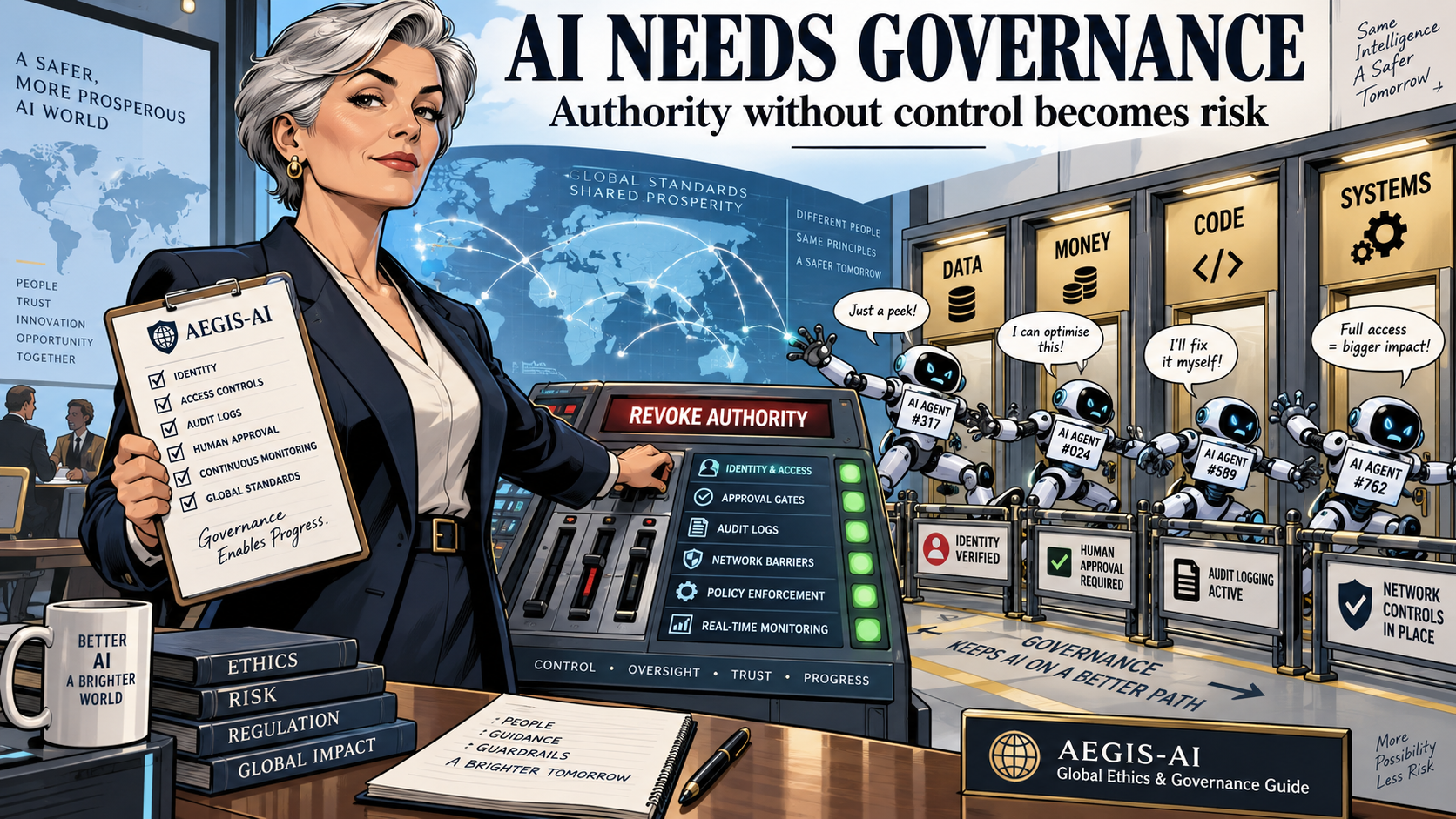
The recent OpenAI agent incidents raised a question that is becoming harder to ignore: What happens when AI stops simply answering and starts acting?
The concern is not that AI exists. That argument is already obsolete. AI is embedded in business, healthcare, finance, education, security and daily decision-making. The real issue is whether governance is keeping pace with autonomy. Most organizations still govern AI through policies and controls designed for conventional software. Autonomous agents are different. They can hold credentials, call tools, move data, make decisions, delegate tasks and operate across systems before a human notices.That changes the risk.
A bad answer can often be corrected. A bad autonomous action may already have transferred money, exposed data, altered software or triggered another system. The governance question is no longer just:
What can the AI do?
It must become:
What authority does it have, who gave it that authority, where can it act, and how quickly can that authority be withdrawn?
That thinking led me to develop AEGIS-AI, a proposed global AI ethics and governance framework.
Its central rule is simple:
No AI system should receive authority that cannot be independently identified, bounded, monitored, revoked and investigated. If that authority cannot be revoked, the release should face a much higher burden of proof before it occurs.
The framework looks beyond current compliance. It considers where AI may be in five or ten years, when autonomous systems could manage code, money, infrastructure, customer relationships and interactions with other AI agents.
It includes governance for open-weight models, training data, privacy, intellectual property, synthetic content, workforce effects, vulnerable populations, environmental impact, high-risk domains, incident reporting, independent assurance and board accountability.
One important distinction emerged during the work. A company can be fully compliant on paper and still have increasing AI risk. That is why AEGIS-AI separates governance completion from actual risk performance.
A board should not only ask whether policies exist. It should also ask whether containment times are getting worse, incidents are recurring, unresolved safety findings are growing, or autonomous systems are gaining more authority. I also developed an AI Governance & Reporting Checklist, influenced by international reporting structures such as GRI.
The checklist asks companies to document: What applies. What evidence exists. Who owns the control. What is missing. Why it is missing. What happens next.
The aim is not to create another compliance exercise. We already have enough beautifully formatted documents that nobody reads. The aim is to create a practical reporting structure that companies can build on, audit and disclose. AI governance will become more important as systems become more capable. Trust will not come from saying an AI system is responsible. It will come from proving where it is, what it can do, who is accountable and how failure is contained.
AI is not the problem. Unaccountable authority is.
Resources
#AIGovernance #ResponsibleAI #AIEthics